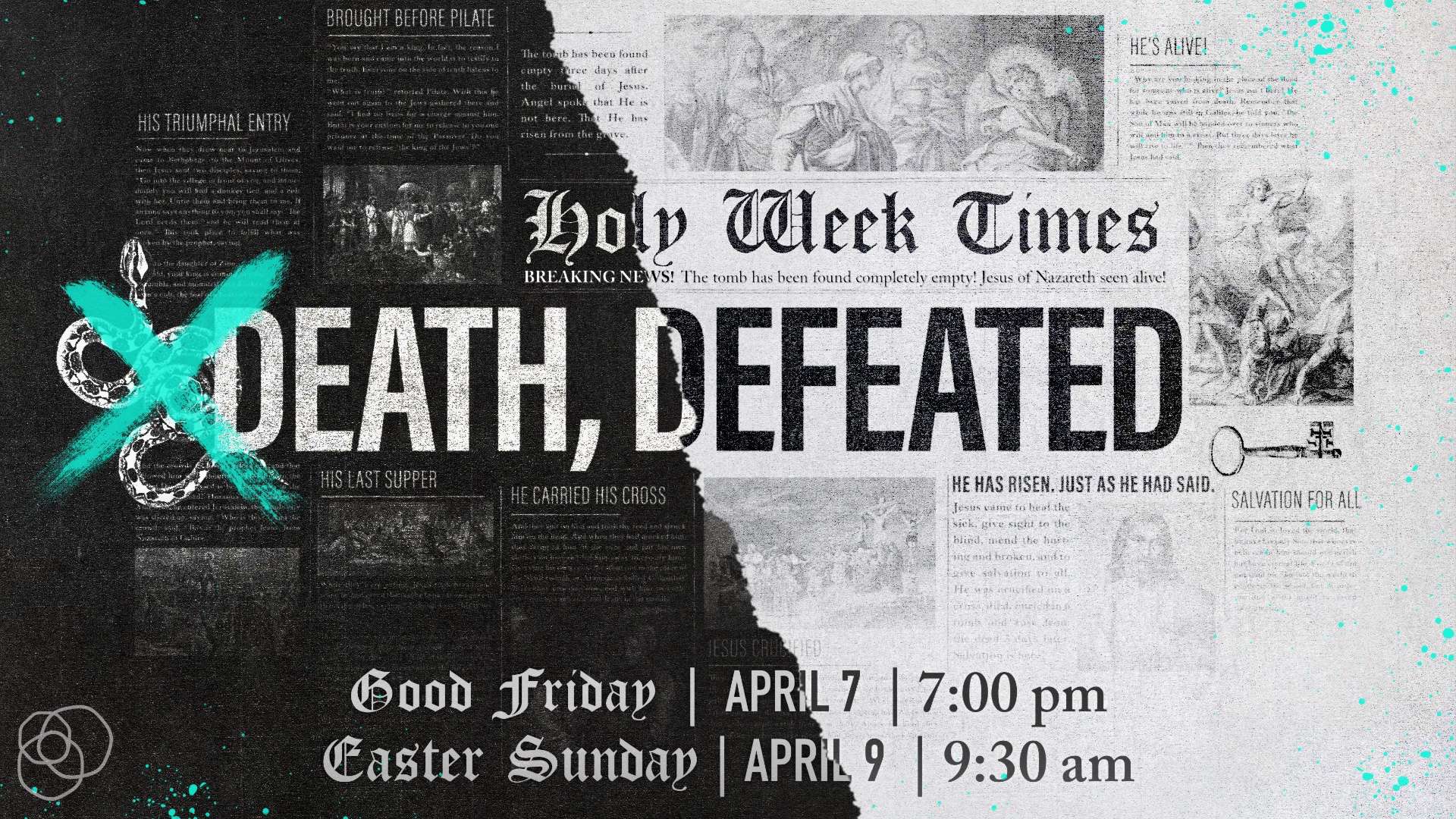
Easter Sunday (Death, Defeated)

He is risen!
He is risen indeed.
I love Easter Sunday, and I especially love having kids in the room for it. You bring so much joy and energy into this place. And I want the kids to know up front: even though some of what we’re getting into today gets a little deep theologically, I think you’re going to get it. I’m not just talking to your moms and dads. This is for you, too. Jesus didn’t just come for adults. He came for kids.
Although I’ll admit — when I was a kid, I’m not sure I would have grasped everything I’m about to say.
I Was Not the Brightest Kid God Put on the Planet
It’s honestly embarrassing to look back and realize some of the things I believed. It reveals that I wasn’t especially good at grasping reality.
Example number one: when I was four, I was convinced I could fly.
I don’t know if it was because my last name is Bird, or because I’d seen Superman, or because I watched The Greatest American Hero. All I know is that I had vivid memories of flying. I now realize those were probably dreams, but at the time I was certain they had actually happened. I have a clear memory of flying from the playset in my backyard to the fence on the other side. I remember flying in my basement.
For some reason I could only fly in spring and summer. I guess the weather had to be warm. I couldn’t fly in the winter. But I knew I could fly — which reveals that I had not quite grasped gravity, or reality.
Example number two: my parents have kept careful oral records of my inability to grasp the lyrics of songs.
One day in kindergarten I came home singing a new song I’d learned in music class, absolutely certain my parents would know it: “We all live in a papa copperin, a papa copperin, a papa copperin.”
My parents looked at me and said, “No. That’s the Beatles. It’s Yellow Submarine.”
Nope. I knew it was a papa copperin. I have no idea what a papa copperin is, but my five-year-old mind had locked it in.
Kids, you know this next one. “I’ve got the joy, joy, joy, joy down in my heart.” See — somebody knows it. That song is now stuck in your head for the rest of the day, and I apologize.
The third verse goes, “I have the peace that passes understanding down in my heart.” But my little five-year-old mind heard, “I have the pickle patch of understanding down in my heart.”
Now, I do like pickles. I have no idea why I wanted a pickle patch in my heart. But again — I did not grasp reality.
By the way, did you know that when you forget or mangle the words of a song, that’s called lyricallitosis? I suffer horribly from this condition.
Where My Misunderstanding Actually Mattered
Unfortunately, my inability to grasp things didn’t stop at gravity and song lyrics. It extended to my faith.
You have to understand that my mom and dad were brand new baby Christians when I was born. My dad became a follower of Jesus shortly before I was conceived, and my mom a few months later, while she was pregnant with me. So I grew up in a home where my parents were genuinely excited about the Christian faith, wanting to learn everything they could — and naturally sharing all of it with their kid.
So I grew up hearing about the miracles of Jesus and the teaching of Jesus. But mostly I heard that Jesus died on a cross for the forgiveness of my sins.
My dad tells the story that when I was four — the same year I was convinced I could fly — I actually did begin to grasp the reality of the cross. I peppered him with questions one day, essentially restating the whole gospel story back to him. He finally asked, “Do you want to put your faith in Jesus?” So I climbed into his lap, prayed an innocent little four-year-old prayer asking Jesus into my heart, then climbed down and went right back to playing with my toys.
I grew up understanding the cross as best I could. But here’s what I did not grasp: the importance of the resurrection.
I thought the resurrection was a nice bonus. What really mattered, I figured, was the death of Jesus on the cross. The penalty of sin is death, Scripture teaches, and Jesus paid that for us. Thank you, Jesus. Oh — and by the way, He also rose again from the dead. Wow. That’s pretty cool.
I did not realize the resurrection is the linchpin of the entire gospel story, and therefore the linchpin of the entire Christian faith. And my failure to grasp that didn’t just last through elementary school. It followed me through my teens and into my twenties.
So if you’re here today and you think this resurrection business is a myth, or a legend, or maybe you accept that it happened but don’t see how it makes much of a difference — I hope today changes your mind.
And if you’re a follower of Jesus, I hope today encourages you. Because the resurrection should change everything.
We’re going to two passages to see why the resurrection is so critical — both to the Christian faith and to our daily lives.
The Road to Emmaus
Open your Bible to Luke 24. If you’re a first-time guest, we’ll put nearly all of the Scripture on the screen, but we really do encourage you to have your own Bible. We don’t care if it’s a digital Bible on your phone or a paper one — we just think it’s important that you have one. We don’t want you studying Scripture only on Sunday. We want you reading it Monday and Tuesday and any day. So either download one to your phone or stop by the resource table and take one. That’s our Easter gift to you.
Before we read, let’s pray.
Heavenly Father, we bow before You right now and ask You to be our teacher. I’ve put time and preparation into this, and yet I’m aware of how weak it all is — that this error-prone, at times hypocritical man could somehow convey truths this important and this weighty in a way we can all understand. I know I’m going to fall short of a subject this significant. So I pray You’d do what only You can do. Speak to the heart and mind of every person here, no matter their age, no matter their spiritual background, no matter what they walked in with today, no matter what they’re wrestling with, no matter what they’re worried about in their future. Speak loud and clear, so we would see not only how important the resurrection is, but how important it is to our lives. In Jesus’s name we pray, amen.
We’ve been walking through Luke during this whole Death, Defeated series. Last Sunday for Palm Sunday we heard Luke’s account of the triumphal entry. Friday at our Good Friday service we read a huge chunk of chapters 22 and 23. And we opened this gathering with Luke 24:1–12. So we’re ready for verse 13.
That very day two of them were going to a village named Emmaus, about seven miles from Jerusalem, and they were talking with each other about all these things that had happened. While they were talking and discussing together, Jesus himself drew near and went with them. But their eyes were kept from recognizing him. And he said to them, “What is this conversation that you are holding with each other as you walk?” And they stood still, looking sad. Then one of them, named Cleopas, answered him, “Are you the only visitor to Jerusalem who does not know the things that have happened there in these days?” And he said to them, “What things?” And they said to him, “Concerning Jesus of Nazareth, a man who was a prophet mighty in deed and word before God and all the people, and how our chief priests and rulers delivered him up to be condemned to death, and crucified him. But we had hoped that he was the one to redeem Israel. Yes, and besides all this, it is now the third day since these things happened. Moreover, some women of our company amazed us. They were at the tomb early in the morning, and when they did not find his body, they came back saying that they had even seen a vision of angels, who said that he was alive. Some of those who were with us went to the tomb and found it just as the women had said, but him they did not see.” (Luke 24:13–24)
Our story starts with two people — we think it may be two men, though there’s a solid theory that it’s Cleopas and his wife. They’re clearly followers of Jesus. They believed He was the Messiah. And they’re able to relay everything that just happened: the women seeing angels, Peter getting to the tomb and not finding the body.
They are thoroughly confused. They have no idea what is going on.
And that’s when Jesus starts to teach.
And he said to them, “O foolish ones, and slow of heart to believe all that the prophets have spoken! Was it not necessary that the Christ should suffer these things and enter into his glory?” And beginning with Moses and all the Prophets, he interpreted to them in all the Scriptures the things concerning himself. (Luke 24:25–27)
Did you catch that? He kind of insults them. O foolish ones. Slow of heart. But notice what they’re slow to believe — all that the prophets have spoken.
Then He starts explaining from Moses and the Prophets. By “Moses,” He means the first five books of the Old Testament. Jews call it the Torah; many Christians call it the Pentateuch. Tradition holds that Moses wrote those books — apart from the last few chapters, which Joshua wrote, since Moses had died.
So Jesus is saying: all the way back to Moses, this was prophesied. Then He walks them through Isaiah and Jeremiah, Daniel and Hosea, showing how the major and minor prophets had been pointing to these very events.
In other words: guys, this was all planned.
Wax On, Wax Off
Has anyone here seen the original Karate Kid? If your hand is up, you’re probably over thirty.
Daniel moves from the East Coast to the West Coast, and his East Coast attitude doesn’t fit in. Pretty soon a group of bullies feels threatened by him — the girl seems to like him — and they start going after him. There’s a scene where Daniel tries to get some revenge, they chase him down, and they start beating him up. That’s when Mr. Miyagi jumps in and uses karate to take the whole group apart.
So Daniel wants to be like Mr. Miyagi. “Will you teach me karate?” Mr. Miyagi very reluctantly agrees.
Daniel shows up excited and ready to learn — and gets handed a paintbrush. Paint the fence. And he has to do it a very specific way. All day long, painting a fence. He hates it, but he figures maybe this is how he pays for the lessons, since he and his mom don’t have money. Tomorrow we’ll start karate.
The next day: wash the car. Wax on, wax off. Then sand the deck.
Finally Daniel hits his limit. “That’s it. I’m done. You’re not teaching me karate.”
And in the pivotal scene, Mr. Miyagi grabs him and says, “Show me — paint the fence.” And as Daniel does the motion, Mr. Miyagi throws a punch. It gets blocked. Another one. Blocked. Again and again.
And Daniel suddenly realizes he’s been learning karate the entire time.
He was confused. But Mr. Miyagi had a plan.
Just like the two on the road to Emmaus. They were bewildered. We thought this was the Messiah. We thought He was going to free Israel from Rome. We thought all these big things — and now He’s dead. And then these women come back, and everyone knows a woman’s testimony won’t hold up in court, and they’re saying He’s risen and angels showed up. One of our guys went and checked, and yeah, the body’s gone, but he didn’t see Jesus. We don’t know what’s happening.
And Jesus essentially looks at them and says: Guys. It’s all going according to plan.
This was not a mistake. It was God’s plan for Jesus not only to come down — God taking on human flesh, living a sinless life — but to die a horrible, torturous death on a cross, only to rise again from the dead.
Even as Jesus hung on that cross, knowing He was about to breathe His last, knowing exactly how painful all of it was, He knew He would live again. We used this passage last Sunday and again on Good Friday, and here it is once more: in John 10:17–18 Jesus says He lays down His life willingly. No one takes it from Him. He has the right and the authority to lay it down, and the right and the authority to take it up again.
And that is exactly what happened.
What Actually Makes Jesus Unique
There is no one like Jesus.
You might say His birth was what set Him apart. After all, He was God incarnate, born of a virgin. But when the shepherds arrived, they didn’t see the Son of God. They saw a baby who looked like every other Palestinian Jewish boy born at that time.
So maybe it’s His death that sets Him apart? No — one hundred percent of people die. Sorry to ruin your Easter. The mortality rate has been remarkably steady. The fact that Jesus died doesn’t make Him unique.
Well, then it’s that He died on a cross? Also no. Thousands upon thousands of people were killed on crosses. I learned this week that in AD 66, Israel revolted against the Roman Empire — what became known as the Great Revolt. Between AD 66 and 70, when the Romans finally destroyed the temple, there were stretches where the Romans were crucifying five hundred Jews a day. Thousands upon thousands died on crosses.
So it is not the cross that makes Jesus unique.
It is the resurrection. Jesus Christ rose from the dead.
“But there are other resurrections in Scripture,” you might say. “The little girl. Lazarus.”
True. But none of them raised themselves from the dead. Only Jesus.
Jesus is unique. And this was the plan all along — which means you can seek Him and trust Him.
No Resurrection, No Gospel
The resurrection is the linchpin. No resurrection, no gospel. No gospel, no Christian faith.
Flip to our second passage: 1 Corinthians 15.
First Corinthians is a letter Paul wrote to a genuinely messy church. They were struggling with divisions and discrimination. They were struggling financially. They were extending too much grace to people who should have known better, and not nearly enough grace to those who desperately needed it. The place was a mess.
I sometimes hear pastors and church leaders say, “We want to be a New Testament church,” and in my head I think, I sure hope you don’t mean the Corinthian church, because that place was awful.
Paul addresses all of it. And then, as he nears the end of the letter, he seems to decide he simply needs to bring them back to what is most basic.
For I delivered to you as of first importance what I also received: that Christ died for our sins in accordance with the Scriptures, that he was buried, that he was raised on the third day in accordance with the Scriptures. (1 Corinthians 15:3–4)
“I delivered to you” — meaning, when I was with you planting this church, sharing the gospel with you, discipling you. “As of first importance” — this is the most critical thing you could possibly get. This is the foundation. “What I also received” — God gave it to me, and I’m handing it to you.
And notice: in accordance with the Scriptures. Twice. Just like Jesus told the two on the road to Emmaus that all of the Jewish Scriptures point to Him, Paul says the same thing. The death and resurrection of Christ was prophesied. It was the plan.
Baseball With an Invisible Ball
Many of you know I’m a bit of a baseball fan. Unfortunately I’m a Kansas City Royals fan, so I am well acquainted with suffering and misery.
Imagine a baseball game where the pitcher steps on the rubber, looks in for the sign, goes into his motion — and there’s no ball in his hand. It’s invisible. He throws it. The batter swings at nothing. And everyone stands around waiting for the umpire to tell them what happened.
“Oh — you swung and missed. Strike one.”
“Oh — that was a foul ball, but the third baseman couldn’t see the invisible ball, so he didn’t catch it in foul territory. Strike two.”
“Oh — actually, that one was a home run.”
It doesn’t work. Take out the baseball and you don’t have the game of baseball.
Same with the resurrection. Take out the resurrection and you don’t have Christianity.
That’s exactly what Paul argues:
And if Christ has not been raised, then our preaching is in vain and your faith is in vain. (1 Corinthians 15:14)
No resurrection, no gospel. No gospel, no faith. You have to have the resurrection. It is what legitimizes the work of Good Friday.
If it helps to think of it this way: Jesus defeated sin on Good Friday, and He defeated death on Sunday.
Firstfruits
But in fact Christ has been raised from the dead, the firstfruits of those who have fallen asleep. For as by a man came death, by a man has come also the resurrection of the dead. For as in Adam all die, so also in Christ shall all be made alive. (1 Corinthians 15:20–22)
Let me unpack that for a minute, especially for the kids.
“Firstfruits” is an Old Testament word. When the Jewish people brought in their harvest, they were supposed to bring the first portion to God as worship. That was the firstfruits. So this is a poetic way of saying the first, and the most important.
But notice what Christ is the firstfruits of: those who have fallen asleep.
Kids, he’s not talking about a nap. Your moms and dads would probably love a nap this afternoon, and I know you’re fighting yours. This isn’t about naps. “Fallen asleep” is a poetic way of describing those who have died. And the reason Paul uses that phrase is that even though they’ve died, they will not stay there. They will be resurrected.
Then he brings in Adam. Adam was the first man ever created. When Adam and Eve ate the forbidden fruit, sin came crashing in. God had warned them that if they ate it, they would surely die — and in that moment, their spirit immediately died. The relationship with God fractured. And physically, they began a slow death. It took decades, and across generations centuries, but they did eventually die physically.
Paul’s point: yes — but Christ came. And through Him, to use Paul’s language, in Christ, if you put your faith in Jesus, you are resurrected spiritually now, and one day you will be resurrected physically.
We don’t have time for all of it, but go back later and read the whole chapter. Paul talks about how even though our bodies die, they’re like a seed, and they will sprout into something new. We will take on spiritual bodies. What is perishable will become imperishable.
If you put your faith in Jesus, you are resurrected spiritually the moment you believe. You already begin to live the eternal life.
Which is why Paul says in verse 26 that the last enemy to be destroyed is death. On Friday, on a cross, Jesus defeated sin. On Sunday, when He rose, He showed He had defeated even death.
Death, Mocked
I almost skipped this one. Look at the end of the chapter, where Paul essentially mocks death:
When the perishable puts on the imperishable, and the mortal puts on immortality, then shall come to pass the saying that is written: “Death is swallowed up in victory.” “O death, where is your victory? O death, where is your sting?” (1 Corinthians 15:54–55)
If you’re a follower of Jesus, this should encourage you tremendously.
It means that when you stand at the funeral of a fellow Jesus follower, you’re not saying goodbye. You’re saying I’ll see you later.
It means the pain and misery and suffering you walk through in this life do not get the last word.
It means there is more to this life — which also means there can be more in this life.
Because the resurrection isn’t meant to be just a great moment in history that leaves us saying, “Wow, Jesus is powerful.” It’s meant to be a motivator. That’s how Paul closes the chapter:
Therefore, my beloved brothers, be steadfast, immovable, always abounding in the work of the Lord, knowing that in the Lord your labor is not in vain. (1 Corinthians 15:58)
The resurrection should motivate you to stay steadfast. To be immovable. To not get swayed by the culture around you, to not lurch up and down, but to stay steady with your eyes on the risen Christ. Because this is not all there is — and what you do here has meaning, and it affects the life to come.
And If You’re Not a Follower of Jesus
Then the resurrection is an invitation.
There is no one like Jesus. He stands completely apart from anyone and everyone. All sorts of religions hand you a list of things you have to do. Jesus, through the resurrection, looks at us and says, I’ve taken care of it. It’s done.
There is nothing you need to do to earn God’s love. What you need to do is accept God’s love. The way Jesus puts it is those who believe upon His name — which is a way of saying that you put all of your faith, all of your identity, into this story of His death and resurrection.
It was the plan all along. It’s the linchpin of the faith. And He now extends His hand and says, will you follow me?
I would love for today to be your spiritual birthday. I would love for you to see the power and truth of this gospel. It doesn’t mean life suddenly gets easier. It means life takes on new meaning.
Right now, when we’re born, we’re born in the likeness of Adam — physical human beings with a sin nature. What God wants to do is transform us so that we’re no longer simply more like Adam, but increasingly like Jesus:
Just as we have borne the image of the man of dust, we shall also bear the image of the man of heaven. (1 Corinthians 15:49)
Our broken, hurting world needs more people who will go and love like Jesus loved and live like Jesus lived. We see His heart for people. We see His humility. We see His willingness to do what He had no obligation to do — He didn’t need to die for His own sins, because He had none. He went to the cross for you, and He showed He had power over all things, even death itself.
And now He extends His hand and says, follow me.
A Prayer to Mark the Moment
Many people, when they realize the truth of this story — that it isn’t just history, isn’t just an account out of an ancient book, but a present reality that can change their here and now — want to mark the moment in prayer. So would you pray with me?
Heavenly Father, I pray right now for anyone listening — here in person, online, or on the podcast later — who has made it this far and realizes You are extending Your hand and inviting them to follow a risen Savior. Lead them right now to confess their sin, to acknowledge their need for You, to surrender themselves and put You first in all things. And as they do, God, You are putting Your Spirit in them. You are beginning the slow transformation of making them less like Adam and more like Jesus — more and more like the man of heaven.
Lord, thank You for what they’ve done, for the decision they’ve made, for the way You have moved in them. Give them fruitful days ahead. Let them know they have a church family here who will love them and support them and disciple them and help them grow to be more like Jesus, so they can go and live like Jesus lived and love like Jesus loved.
And Lord, I pray for my brothers and sisters in Christ who are here. They know these things. They even believe them. And yet some of them feel a little like those two on the road to Emmaus — confused about how life has been going, not understanding where You are or why You aren’t answering their prayers. I pray that today they would see the resurrected Christ and hear Him saying, “Trust me. Follow me. Everything is going according to plan.”
Jesus, thank You for what You did. It is absolutely remarkable that You set aside Your throne in heaven to come to this earth, to take on human flesh, and to enter into our suffering with us. And that wasn’t enough for You — it wasn’t enough to simply show us that You can identify with us. You went to a cross and paid the price we should have paid for our sin, so that You could give us the life You had always desired for humanity to live.
So Father, help us follow You. Help us trust You. Help us see a risen Jesus and realize that through Him, death is defeated — and we can walk in that victory and find joy in it. In Jesus’s name we pray, amen.
He is risen. He is risen indeed.