
Psalm 61 (Summer of Psalms #6)
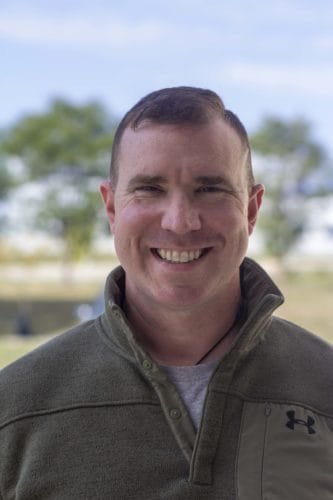
I am recording this at sunrise, standing in the Imperial Dunes in California. I am currently on sabbatical from my role as an elder, deployed with the Iowa National Guard to the southwest border. I am not far from the border wall — it sits just over the hill behind me, and we are not going to walk over there this morning. But this place helps make the point of our psalm today.
It is pleasant right now, before the sun climbs. By midday it gets brutally hot. This is a recreational area; people actually choose to come here. I am looking out in the other direction, and there is simply nothing. Nothing at all.
We are going to walk through Psalm 61. David is the psalmist. If you have a copy of God’s Word, open it up with me — your page numbers may differ from mine.
The Text: Psalm 61
“Hear my cry, O God; attend to my prayer. From the end of the earth I will cry to You, when my heart is overwhelmed; lead me to the rock that is higher than I. For You have been a shelter for me, a strong tower from the enemy. I will abide in Your tabernacle forever; I will trust in the shelter of Your wings. Selah. For You, O God, have heard my vows; You have given me the heritage of those who fear Your name. You will prolong the king’s life, his years as many generations. He shall abide before God forever. Oh, prepare mercy and truth, which may preserve him! So I will sing praise to Your name forever, that I may daily perform my vows.”
Father, we are thankful to open your Word, to contemplate the musings of people in the past inspired by your sovereign hand and the will you had for their lives — that you moved them, and that you move us. Thank you for the gift of understanding your Word and your will. Help us parse this passage, understand what David was going through, take it in, and apply it properly. Let us see what you want us to see and hear what you want us to hear. Cover over my failings, my words, and my stumbling. And even though I am doing this from far away, be sovereign over it, as I know you are. Help each of us to understand, and to come to love the way you love. Amen.
Being Far From What You Know
Being far away from what you normally do is genuinely hard. I know that firsthand right now.
I am far from the comforts I experience at home. Far from the routine I rely on, the same way some of you rely on yours. That routine is what I know and what I love. And I am doing something I ultimately have very little desire to do. I do it out of obligation.
And here is the thing: the set of circumstances that brought me here are the results of my own choices.
Our lives form an arc of experience, and we are not passive riders on it. We are participants in what we are doing. The choices we make are our own. We reap what we sow.
You probably understand some of that.
David Was in a Similar Place
In our psalm today, David finds himself somewhere much the same. We will not dwell on the history too long, but it is the part I find most compelling.
David most likely wrote this during the time of Absalom’s rebellion. Absalom was one of David’s sons, and he drove his father away from the throne. David, wanting to avoid bloodshed, chose to flee and put distance between himself and his own kingdom. But Absalom came anyway.
And Absalom acted as the result of a chain of events. A different son of David had raped a daughter of David, and Absalom would not tolerate it. He saw the failings of his father.
So how could David — this great king — have produced all of this?
Go all the way back to when David first brings the ark home. He is dancing in the streets, having stripped off his royal garb to be down on the ground among his people, celebrating, having a wonderful time. It is beautiful. And his first wife scorns him for it, mocking him for dancing like a commoner.
That scorn damaged David. From that point forward he multiplies wives. He and that first wife are never reconciled for the rest of their lives.
It is a terrible thing, and it is worth studying in terms of marriage and how we speak to and treat one another. Several teachings I listened to while preparing for this dwelt on exactly that. It is worth going and reading — and so is the account of Absalom’s rebellion. Go read them.
But that dysfunction, that departure from the way God intended things to be, set off a series of events that never healed. Because David multiplied wives, all of this followed.
And so David finds himself driven away from every comfort, as the result of his own choices. He finds himself at the end of the earth.
“From the End of the Earth I Will Cry to You”
Was David literally at the end of the earth? The earth goes around, so no. But that phrase resonated with me standing here at the end of our country, at its very edge. It is a desolate, unpleasant place to be.
So what does David remember, surrounded by trials created by his own sinfulness? What did he have left? Did he have a guard with him? What comforts remained? We do not know.
But he did carry something with him.
Do you remember God’s promises?
Read the opening again: “Attend to my prayer. From the end of the earth I will cry to You, when my heart is overwhelmed; lead me to the rock that is higher than I.”
You could spend a long time on that phrase alone.
When my heart is overwhelmed. He is grieved to be where he is. He is desperate. He is undone. Overwhelmed.
Lead me to the rock that is higher than I. That is Christ.
There is so much stability language, so much rock language, attached to Christ throughout Scripture. And even here in the Psalms, in the Old Testament, you see Jesus — who is the rock. The rock in everyone’s lives. The rock of the universe. All of creation is built on him. He is the Word made flesh. And he is the point of everything we are doing here, everything we are talking about, everything we are studying.
Lead me to the rock that is higher than I.
What David knows about Jesus is what leads his prayer.
Does it lead yours?
Shelter, Tabernacle, Wings, Tower
Christ is a shelter for you. He is your tabernacle. His great wings are your covering.
That language builds in you a picture of the person of Christ and what he is in your life — a strong tower, a place of cover, a place of shelter and stability.
He is not like the sand out here.
There is sand everywhere. The dunes here rise more than three hundred feet. But it is shifting sand. The border wall itself, on the other side of this hill, is built on platforms and has to be moved, because the sand blows so relentlessly. There is no snow here, but there are sand plows — because the sand piles into dunes across the road and will flip a truck. It is genuinely remarkable to see.
But it is constantly shifting. There is nothing stable about it.
And here, in his desperation, David remembers who Christ is. He is a rock. He will not move. He is the thing that is stable. He is the shelter. And in that desperation, David remembers the one place he ought to properly send his prayers.
How wise would it be for us to do the same?
He Remembers the Heritage
“You have given me the heritage of those who fear Your name. You will prolong the king’s life, his years as many generations.”
Sometimes the language in David’s psalms overlays the promise of the coming Messiah. It is a both-and. David knows God will keep his promise to him personally, and he also knows that the heritage of his line is the Messiah. Out of the Davidic line comes Christ.
And with that understanding, his prayers become properly ordered: “Oh, prepare mercy and truth, which may preserve him.” He is talking about himself. He is also talking about Christ.
“So I will sing praise to Your name forever, that I may daily perform my vows.”
Prayers Offered in Dryness
There is another image that settled on me as I worked through this psalm — not reading myself into the psalm, because it is very specific about what it is about, but applying what is happening here.
Part of it is understanding prayer itself. Part of it is understanding something of God’s character. Let me start with God’s character.
There are times you see your children, or someone you are helping to teach, and God relates to us much as we relate to them.
Let me put it in terms of my own children. There are moments when I am standing off at a distance and my children perceive my absence. To them, I am not there. But I can see them. I am always with them. My will carries them. I have given them instruction. I have spent time preparing them to go out into the world.
And then there are those glimpses I catch when they are operating among themselves. I am thinking of one specific instance when they were treating each other genuinely well, playing together in the yard, having finished the work I asked them to do, continuing on in obedience to something I had given them earlier. They remembered it, and they went out and did it.
My heart was full. I was so satisfied watching them. It was beautiful. They had learned. How wonderful is that?
Now, in C.S. Lewis’s The Screwtape Letters — a wonderful book, and if you have not read it, you should — there is a striking observation along exactly these lines. The book is written as letters from a senior demon to a junior one, so everything in it is inverted, and I am not quoting it as authority. But the observation is a good one.
The idea is this: God does not let those warm, felt seasons of his nearness last forever. Sooner or later he withdraws — if not in fact, then at least from a person’s conscious experience. He leaves the creature to stand on its own legs and to carry out, from the will alone, duties that have lost all their pleasure.
And here is the piece that lands hardest: it is during those trough periods, far more than during the peaks, that a person is actually growing into the sort of creature God wants them to be. Which means the prayers offered in a state of dryness are the ones that please him most.
Lewis’s demon goes further, admitting that the enemy’s cause is never in greater danger than when a human being — no longer desiring, but still intending to do God’s will — looks around at a universe from which every trace of God seems to have vanished, asks why he has been forsaken, and still obeys.
Have You Been There?
Have you been where David was — cut off from everything?
Have you been where that person in Lewis’s letters is — seemingly alone, though you are never actually alone?
Never alone.
Where do you look when you are desperate? When you do not have the comforts of home? When your prayers have nothing left to draw on but memory?
All the posturing you are used to — the folded hands, the bowed head, the closed eyes, the whole sacred posture and that felt sense of presence — is cut off. There is nothing good happening around you and you are completely alone.
What do you remember?
That you are not alone. God is always there. He is always watching. He is always present. His will carries you, always.
You must remember that. You must. It is pleasing to God.
And do we not want that? Do we not want to understand his will for our lives?
Understanding that will is of immediate, pressing importance. This Word is something we need to come to rely on, to rest on, to remember, and to carry with us.
“That I May Daily Perform My Vows”
“So I will sing praise to Your name forever, that I may daily perform my vows.”
David had made promises. He had taken on obligations. And he remembered that he had promises to keep.
I have vows in my marriage. I have promises I have made to my children, my family, and my friends. I have obligations at work. Those things carry me forward, the way God’s Word carries me forward. They give me a focus for the day.
Even when I am alone out here, I do not want some vain repetition running my life. I do not want a desire for a certain aesthetic or a certain image running it either. I want it to be God’s Word that carries me — the promises I have made to him, and the promises he has made to me, the things he has told me. I want those to guide.
Every step I take, every word that comes out of my mouth, how I move my hands and feet in this world — all of it is up to him, because of him, for him, for his sake and his glory.
I want to honor my Maker, my Lord, my King, Jesus Christ.
I want the same for you.
Do you want that?
And I am not making an appeal to the intensity of your desire. I am asking you to see how good God is, and to respond to it — sometimes in desperation, so that you come out of it into praise, and can go do what God wants you to be doing.
Remember that.
Please, sit in God’s Word. Contemplate it — sometimes in desolation, sometimes in praise, in every season of life. Because we are all in different seasons. I am in an odd one right now.
I pray that each of you is well. I look forward to seeing you again, including those of you I have never met. I am genuinely excited to meet you, to study with you, to learn with you, and to talk about Christ with you.
Let Us Pray
Father, thank you for the gift that is your Word, and for the time we have to come together.
I ask that you would indwell each one of us, press on us with your presence, and help us to feel emboldened at times — but above all to rely on your will as we move through our day, to remember what you have told us, and to keep our vows.
Help us, Lord, to do these things. We are so lost without you. We need you always.
And if it is necessary for us to be placed in situations where we finally realize that all we have is to look up — that all we have is you — then so be it. Father, I ask it. It is a frightening thing to ask, but we ask it.
I pray this in the name of my Lord and Savior Jesus Christ. Amen.